
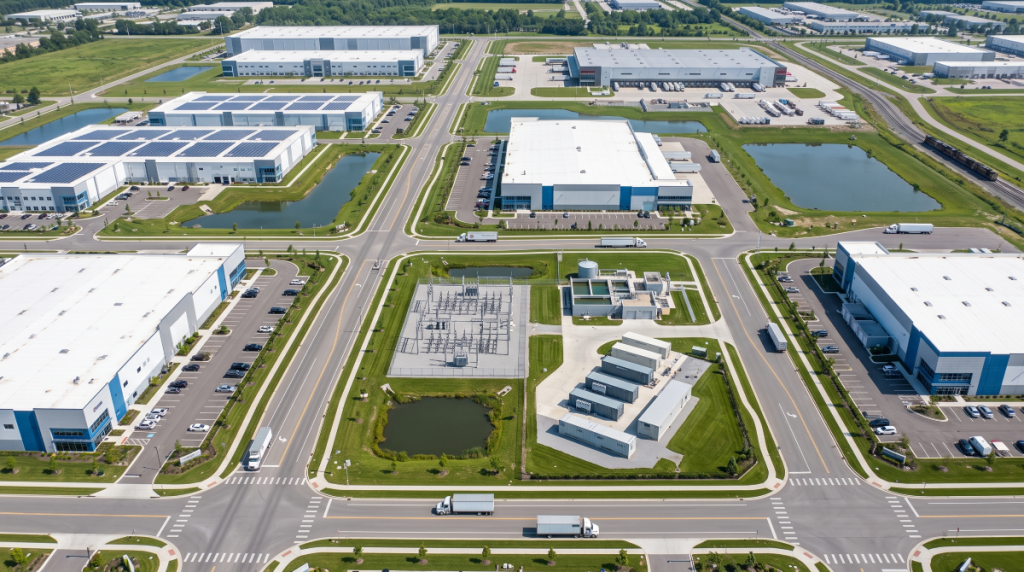
Unplanned factory downtime is the most expensive hidden cost in manufacturing. We explore how modern managed industrial parks in Malaysia engineer out infrastructure failures, flooding risks, and utility disruptions to guarantee continuous business operations.
When an industrial property buyer evaluates a new factory, the focus is typically on the physical structure: the ceiling height, the floor loading capacity, and the layout of the loading bays. These are critical metrics, but they assume that the external environment will function perfectly.
The reality of manufacturing in Malaysia is often far less predictable.
A power dip lasting mere seconds can force a complex manufacturing line to reset, destroying in-progress materials and costing thousands of ringgit in lost time. A sudden tropical downpour that overwhelms municipal drainage can sever road access, leaving outbound freight stranded in the yard. In the industrial sector, the building is only part of the equation; the surrounding infrastructure dictates your reliability.
When assessing risk, we must remember that “Different properties solve different problems.”
For a manufacturer where missed delivery windows result in severe financial penalties, the priority shifts from acquiring the cheapest square footage to securing the most resilient operating environment. The central question for high-value production is invariably: “What does the buyer need the property to do?” If the answer is to maintain 24/7 uninterrupted operations, the traditional unmanaged industrial lot carries significant structural risks.
Proactive Versus Reactive Infrastructure
The fundamental flaw of an unmanaged industrial area is its reliance on reactive municipal maintenance.
When a pothole forms on a primary access road, or when a public drainage reserve becomes clogged with industrial debris, the property owner must lodge a complaint with the local council and wait. Repair timelines are subject to municipal budgets and bureaucratic scheduling. During this waiting period, your logistics suffer.
Managed industrial parks operate on a completely different paradigm.
Governed by a strict operational framework, the park manager takes ownership of the common infrastructure. Maintenance is proactive rather than reactive. Drains are cleared on a rigid schedule. Roads are patched before they deteriorate into hazards.
This environment treats infrastructure as a mission-critical asset rather than a public utility. By internalising the maintenance of the estate, a managed park effectively removes the local council bottleneck from your supply chain.
Mitigating the Flood Risk
Climate resilience is no longer an abstract environmental concept; it is an urgent industrial necessity.
Recent years have demonstrated the devastating impact of sudden flash floods on Malaysian industrial zones. In older, piecemeal developments, drainage systems were rarely designed to handle modern rainfall intensity. Furthermore, because properties were built by different developers over decades, there is rarely a cohesive water management strategy. Water simply flows from the highest lot to the lowest, frequently inundating older factory floors and ruining millions in inventory.
A master-planned industrial hub approaches water management holistically.
Before a single factory is constructed, the developer engineers a comprehensive, estate-wide mitigation strategy. This involves deep, high-capacity master drainage networks, integrated retention ponds, and blue-green corridors designed to safely channel extreme water volumes away from production facilities. For the business owner, this level of macro-engineering provides a safeguard that is physically impossible to achieve when buying an isolated lot.
Power Stability and Digital Resilience
As manufacturing transitions towards Industry 4.0, operations are increasingly reliant on automation, robotics, and real-time data analytics.
These technologies demand absolute network stability and flawless power delivery. In older industrial areas, the electrical grid is often stretched to its limit. Voltage fluctuations are common, and the telecommunications infrastructure relies on aging copper lines or congested public cellular towers.
Modern managed parks are designed around the concept of “The Digital Twin”.
By integrating dedicated sub-stations and robust dual-feed power supplies, these parks insulate tenants from external grid instability. Crucially, premium managed hubs are increasingly integrating private 5G networks and centralised fibre-optic backbones directly into the master plan.
This low-latency connectivity is not a luxury; it is the prerequisite for modern manufacturing. It allows automated guided vehicles (AGVs) to navigate the factory floor seamlessly and permits off-site managers to monitor machine health in real time, catching mechanical anomalies before they result in a catastrophic equipment failure.
Securing the Perimeter
Downtime is not only caused by utility failures; it is also caused by security breaches.
In a traditional setting, security ends at your front gate. You hire your own guards and install your own cameras, but the public road outside remains vulnerable to cargo theft, illegal dumping, and vandalism.
A managed ecosystem pushes the security perimeter far away from your front door. With 24/7 AI-integrated surveillance, License Plate Recognition (LPR) at the main entry points, and a dedicated central command centre, the park manager monitors the entire environment. Threats are identified and neutralised before they ever reach your loading bay.
The strategic value of a managed industrial park lies in what it prevents. By engineering out the common causes of operational friction—flooding, power dips, logistical bottlenecks, and security threats—the managed environment acts as an insurance policy for your production line. While the initial capital expenditure may reflect this premium infrastructure, the return on investment is measured in the hours, days, and weeks of continuous, unbroken operations.
About the Author
The author is a licensed Real Estate Negotiator with PropNex Realty Sdn Bhd E(1)1800, focusing on commercial and industrial property. Leveraging over 26 years of expertise in writing, digital marketing, and property content strategy, she oversees platforms like klproperties.my and industrial-hubs.com. Her approach combines market intelligence with consultative negotiation, enabling business owners and institutional investors to align their operational requirements with resilient real estate solutions.
#IndustrialPropertyMalaysia #FactoryDowntime #SupplyChainStrategy #IndustrialPark #MalaysiaManufacturing