
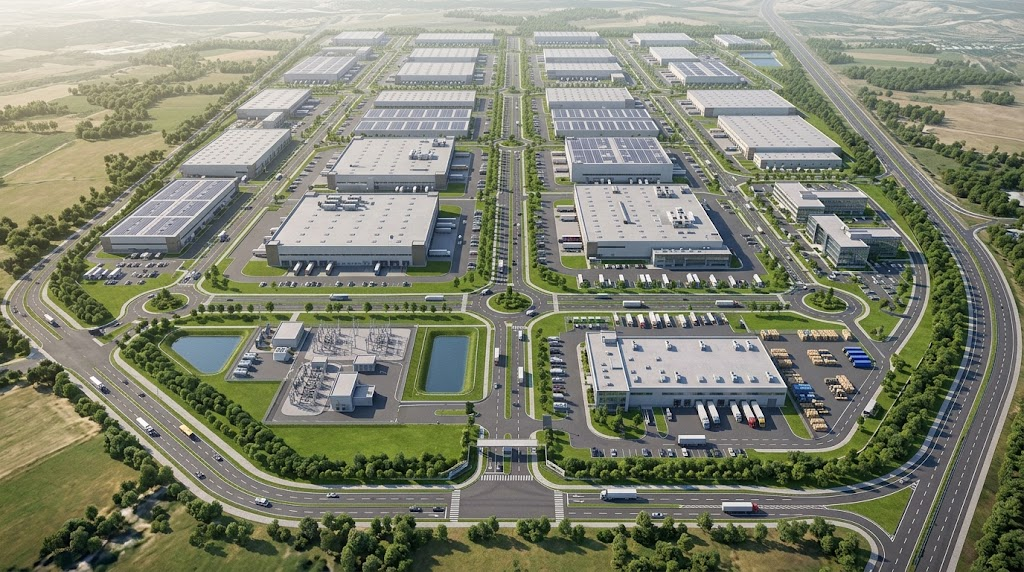
Understanding the strategic gap between a Managed Industrial Park and a traditional unmanaged lot is essential for business continuity in Malaysia. For institutional investors, manufacturers, and logistics operators, choosing the right industrial ecosystem goes beyond the physical building; it is a fundamental de-risking strategy that impacts long-term operational efficiency, ESG compliance, and asset valuation.
For the modern business owner or institutional investor, industrial real estate is no longer just a structural container for machinery and goods.
It is the operational heart of the business. The Malaysian government, through agencies such as MIDA and the Ministry of Investment, Trade and Industry (MITI), has increasingly favoured the “Managed Industrial Park” model. This is not merely a branding exercise by property developers. It is a state-sanctioned method for ensuring industrial longevity and supply chain resilience.
To evaluate the strategic gap between a modern managed hub and a traditional standalone factory lot is to understand the profound difference between proactive asset appreciation and reactive asset decay.
When evaluating industrial property, the traditional approach often revolves around a simple calculation of land area, built-up space, and the lowest possible entry price. However, a property with a lower purchase price may not necessarily be the better choice if it creates operational bottlenecks. Unmanaged industrial areas frequently suffer from poor traffic circulation, inadequate power infrastructure, and fragmented maintenance. The consequences of these hidden deficiencies usually manifest years after the purchase, dragging down both business efficiency and future resale value.
Different properties solve different problems.
The key question is always what the buyer needs the property to do. If the goal is seamless integration into global supply chains, strict ESG compliance, and 24/7 uninterrupted operations, the surrounding environment is just as critical as the factory walls.
The Advantage of Centralised Governance
The core differentiator of a premium industrial hub is the “Master Services Agreement”.
This legal and operational framework appoints a centralised management body that effectively acts as the “City Manager” for the entire development. In a traditional, unmanaged industrial area, the property owner bears the sole burden of everyday friction. From hiring individual security guards and managing private waste disposal to negotiating with the local council for basic road repairs, the owner’s resources are constantly diverted away from their core business activities.
In a managed park, the manager architects a unified, seamless service layer.
This governance ensures that the park’s common areas, security protocols, landscaping, and digital infrastructure are maintained to a uniform, world-class standard. For the investor or owner-occupier, this centralised oversight actively mitigates the risk of “Neighbour Decay”.
We see this phenomenon frequently in older, unmanaged industrial zones across Malaysia. One poorly maintained lot—perhaps operating as an illegal recycling facility, indiscriminately parking heavy vehicles on the road shoulder, or neglecting basic building maintenance—can drastically drag down the valuation and operational efficiency of the entire row. A managed environment prevents this through strict, mutually agreed guidelines that protect the integrity of the entire ecosystem.
Strategic Comparison: Traditional vs Managed Hubs
To clearly illustrate the operational differences, it helps to compare the foundational elements of both models. The table below outlines how responsibilities and infrastructure provisions differ between the two environments.
| Feature | Traditional Unmanaged Lots | Managed Industrial Parks (MIP) |
| Security | Fragmented; reliant on individual guards | 24/7 AI-integrated security, LPR, facial recognition |
| Connectivity | Standard public telecommunication lines | Integrated 5G, centralised data centre, low latency |
| Infrastructure | Reactive maintenance by local council | Proactive digital monitoring, governed by agreement |
| Flood Mitigation | Owner’s individual responsibility | Integrated 100-year master drainage, blue-green corridors |
| ESG Compliance | Difficult to verify independently | Centralised waste/solar systems, GreenRE-certified hub |
| Command & Control | Non-existent oversight | Smart Command Centre with 24/7 park oversight |
Technological Integration and Digital Visibility
A premier smart industrial development uses the managed model to offer technological advantages that standalone lots simply cannot replicate.
By synthesising robust 5G connectivity with an Integrated Operations Centre, the modern park operator can offer highly advanced “Digital Twin” capabilities.
This level of digital infrastructure allows tenants and owners to evaluate their energy usage, logistics flow, and site security status in real time through a centralised digital dashboard. The low-latency nature of a purpose-built, 5G-enabled park is absolutely essential for Fourth Industrial Revolution (4IR) applications. Operations such as remote machinery control, automated guided vehicles (AGVs) on the factory floor, and real-time inventory tracking require a level of network stability that standard public infrastructure in older industrial areas struggles to provide.
Furthermore, robust connectivity ensures that security is proactive rather than reactive. Instead of relying on a tired guard in a sentry box, a managed park utilises License Plate Recognition (LPR), perimeter intrusion detection, and AI-assisted surveillance to secure the entire industrial community.
Fulfilling Global ESG Mandates
Environmental, Social, and Governance (ESG) compliance is no longer an optional public relations exercise. For manufacturers supplying multinational corporations, it is a strict prerequisite for doing business.
Managed parks inherently foster an environment of “Industrial Symbiosis”.
The park manager can facilitate centralised environmental services that would be heavily cost-prohibitive for a single factory to implement independently. Shared industrial wastewater treatment plants, centralised solar energy grids, and coordinated waste-management protocols allow individual businesses to lower their carbon footprint effortlessly.
Being part of a formally managed park makes securing and maintaining ESG certification significantly easier. The developer provides the necessary physical hardware—such as solar-ready roofing structures and integrated rainwater harvesting systems—alongside the vital data reporting required by global auditors. When a European or American multinational audits a Malaysian supplier, the ability to produce verifiable, park-wide energy savings reports and transparent waste tracking data provides a massive competitive advantage.
Addressing the Operational Realities
When analysing industrial property for a business’s own use, the focus must remain squarely on the realities of daily operations.
Heavy-vehicle accessibility is a prime example of where unmanaged parks often fail. A detached factory might look perfectly adequate on a floor plan, but if the public access roads are too narrow for a 40-foot container to turn safely, or if neighbouring businesses constantly block the loading bays with haphazardly parked lorries, the property fails its primary purpose.
A carefully managed industrial estate dictates vehicle circulation.
It ensures road widths, turning radiuses, and parking protocols are strictly enforced. This means receiving raw materials and dispatching finished goods happens on a predictable schedule, free from the logistical bottlenecks that plague older industrial zones.
Furthermore, infrastructure resilience is paramount. Flooding has become a serious concern for manufacturers and warehouse operators in Malaysia. While an individual owner in an unmanaged lot might build a higher retaining wall, a managed park approaches flood mitigation holistically. By incorporating sophisticated master drainage systems and natural retention ponds, the entire estate is engineered to protect valuable inventory and machinery from extreme weather events.
The Next Strategic Priority
While a managed park ensures the physical asset and vital infrastructure remain elite, the most critical component of any production line remains the human element.
Solving the labour challenge is the next strategic priority in industrial acquisition.
An industrial facility is only as effective as the workforce that operates it. Managed parks increasingly recognise this by incorporating purpose-built, centralised workers’ accommodation that meets strict government standards (such as the Workers’ Minimum Standards of Housing and Amenities Act 1990). By housing workers safely and comfortably within or adjacent to the industrial ecosystem, businesses reduce transportation complexities, improve staff retention, and satisfy the social pillar of their ESG requirements.
Ultimately, the decision between an unmanaged lot and a managed hub comes down to a business’s appetite for risk. A traditional standalone factory leaves the owner exposed to external variables beyond their control. A managed environment absorbs those variables, allowing the business owner to focus entirely on production, expansion, and profitability.
If your business relies on certainty, the strategic choice is clear.
Are you evaluating industrial properties for your business expansion or investment portfolio?
Choosing the right industrial ecosystem requires a careful analysis of your operational logistics, power requirements, and long-term business strategy. Contact me to discuss how different industrial properties align with your specific manufacturing or warehousing objectives.
About the Author
The author is a licensed Real Estate Negotiator in Malaysia. Backed by 26 years of experience in market research, content strategy, and digital marketing, she combines thorough property analysis with hands-on transaction support. Working closely with business owners and owner-occupiers, she focuses on identifying strategic commercial spaces and guiding clients through smooth acquisitions that match their long-term operational needs.
#IndustrialPropertyMalaysia #ManagedIndustrialPark #FactoryForSale #PropertyInvestment #SupplyChainStrategy